
10 November, 1899
Called
1. Bosworth. about foreign production & publication of new opera.
He to be my representative in Germany & Austria, with
Bloch-Erben (Ferenzcy [sic]) as his agents, at 20 p.c.
2. Byng & Coates – latter to sing “Ab: M. Beg” –
Today Sullivan notes visits from three gentlemen. Meeting number 1 is some business, which we’ll handle quickly. Meeting number 2 leads to the amazing, astonishing, premiere of The Absent Minded Beggar, a gala evening I hope you’ll attend with me.
First, the business. Bosworth was Arthur Edwin Bosworth, founder of Bosworth & Co., a music publisher in Leipsig, Germany. That company had been started up ten years previously, with investment from Chappell & Co., specifically to handle sales of Chappell publications in Germany and Austria. Some of their books included German translations of Gilbert & Sullivan works, like The Mikado and The Gondoliers. By an amazing coincidence, in this same year of 1899, two New York Architects partnered up to launch the firm of Chappell and Bosworth. No relation. What a world!
Felix Bloch Erben is a literary agency in Berlin, still going strong today. I don’t know who Ferenczy is, but that is a Hungarian surname. The new opera is of course The Rose of Persia, which will premiere 19 days from now. Sullivan will receive a 20% royalty on German sales; this is a good deal for him, although European sales of his works are usually scant compared to those in Britain.
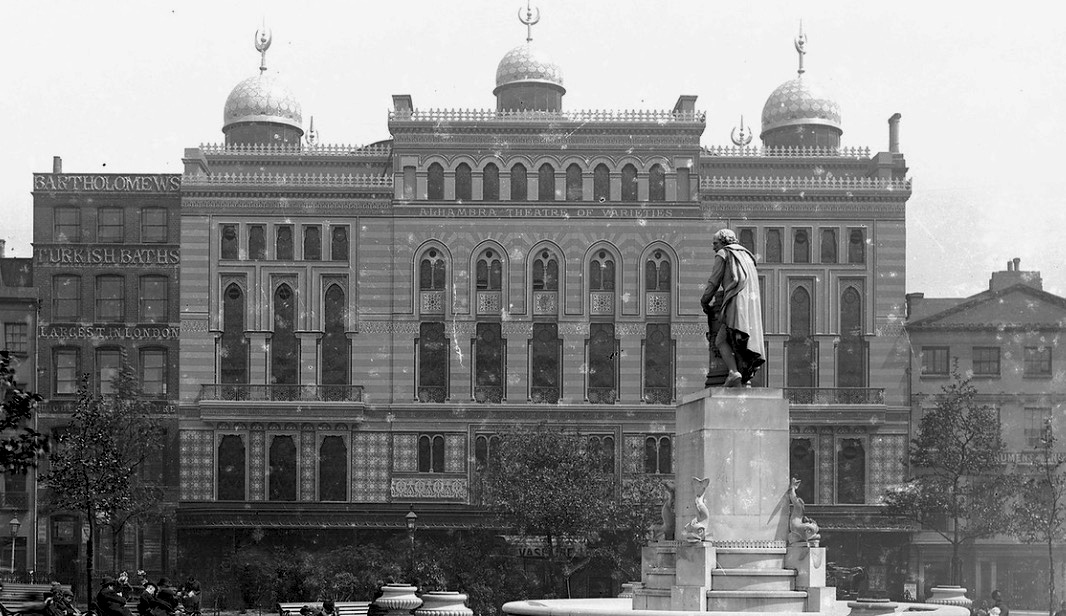
Sullivan’s second meeting concerns The Absent Minded Beggar. As we saw in Part 1 of this series, Sullivan has agreed to set the poem by Rudyard Kipling to music, for a charity scheme invented by The Daily Mail newspaper. The subsequent sales of the poem and song are meant to raise money for British military families during The Boer War. Sullivan has taken a few hours away from rehearsing and scoring The Rose of Persia to compose the song. Three days ago he sent a “printer’s copy” of the song to The Daily Mail for publication, and sent his autograph manuscript of the score to George W. Byng, the house composer at the Alhambra Theatre (shown above). Presumably, Byng has by now completed an orchestration of the song and has brought it along with him.
Coates is the tenor John Coates. Coates is a classically trained operatic tenor who sang many opera and musical roles in London and the US, but fans of the Savoy Theatre may know him best as Mr. Goldbury in the brief, disastrous American run of Utopia, Limited. Next Monday, 13 November, Coates will sing the premiere of Sullivan’s Absent Minded Beggar at the Alhambra. Today is probably his first rehearsal, he will get one more with the orchestra the day of the show.
A Sullivan Premiere!
Today, when we imagine the premiere of a new work of Sir Arthur Sullivan, especially one in 1899, when Sullivan has been England’s best known composer for 25 years, what might we think of? Perhaps a line of luxurious, four-wheeled carriages, pulled by perfectly matched pairs of magnificent horses, out of which emerge impeccably dressed gentlemen, wearing bespoke suits and top hats of silk or beaver, escorting ladies in the latest Parisian frocks. Inside the theatre, everyone is installed in boxes in the sky, all awaiting the entrance of the nobles—invariably late—will it be Princes or Princesses?
Well, the Alhambra is a little different. Built on London’s Leicester Square, on the site where now stands the Odeon Luxe Cinema, the Alhambra went through many incarnations over several decades. In the 1860’s and ’70s, Leicester Square was hardly the chic West End destination of today, but rather was known as a dirty, shady district inhabited by immigrants. (Huh…) Over time the Alhambra was fitted out variously as a sort of science center, then circus, then dining hall with circus acts overhead, music hall and theatre. Elaborate ballets were staged, featuring young women in tights. Critics wrote that many of the danseuses couldn’t dance, and they passed their downtime in the Alhambra’s popular Canteen (a large bar), flirting with men. Along with the ballets were circus acts, singers, and comedians, and also patriotic singalongs and spectacles celebrating the British Empire. Some of these inflamed political spirits in the crowds:
Here “patriotic songs” were the piece de resistence, and towards 11 o’clock a dense throng waved flags and cheered and hooted indiscriminately the “Marseillaise,” the “Wacht am Rhein” and everything and everybody. Jones, calmly smoking, would, without the slightest provocation, assault Brown, who was similarly innocently occupied, and who in turn resented the polite distinction. Stand-up fights took place nightly, and as was anticipated, drew all London to the Alhambra towards 11 o’clock.
London in the Sixties, with a few digressions by One of the Old Brigade.
But that was then, and now it is 1899. The Alhambra burnt down in 1882 and was reopened as a proper theatre two years later.
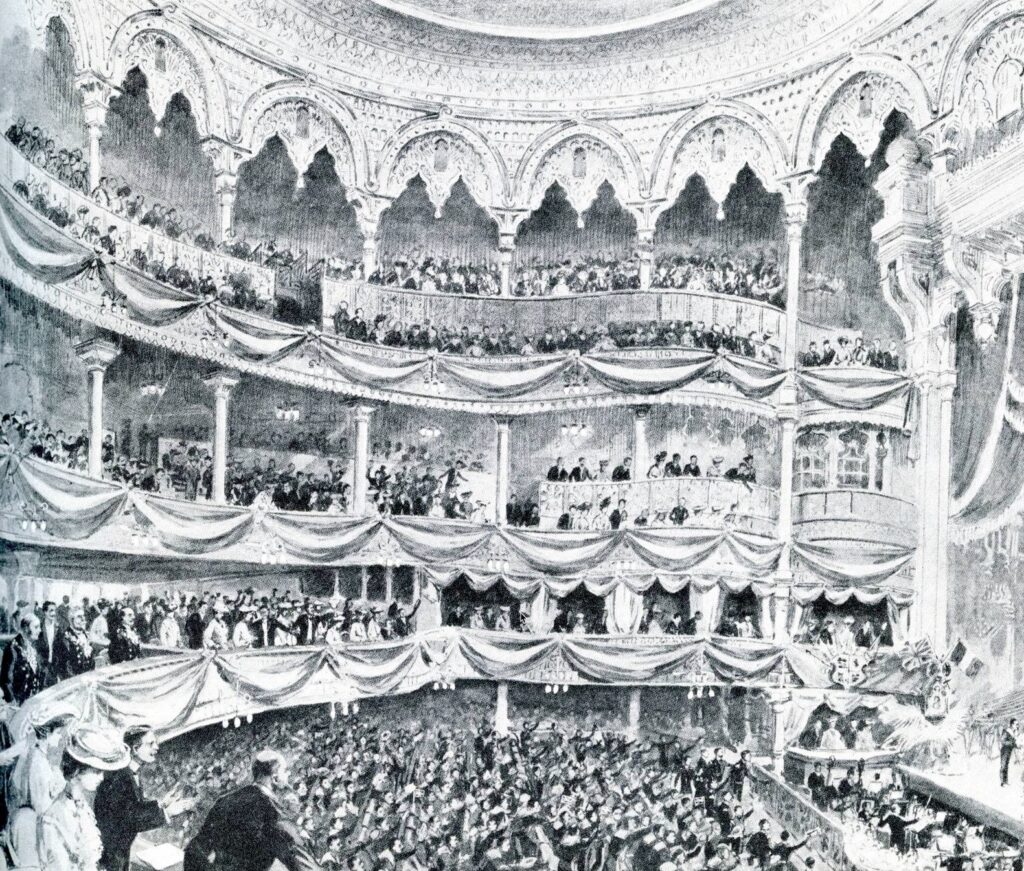
Ok, that looks more like a venue for Sir Arthur Sullivan, right? Well, here is the program for the Alhambra Theatre presentation of 13 November, 1899:
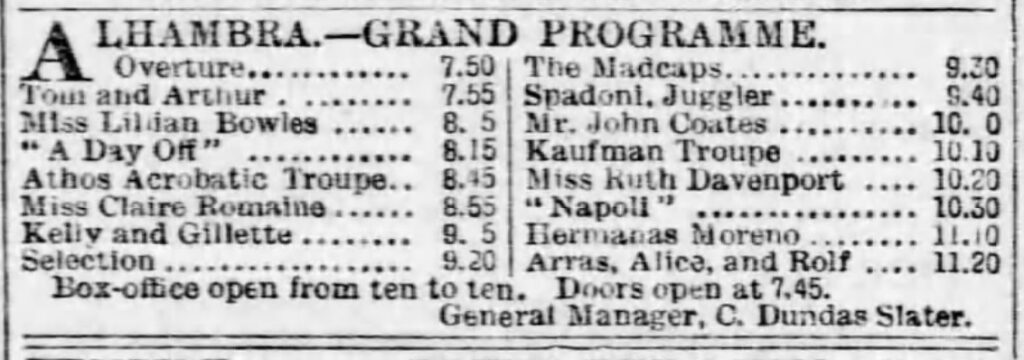
The theatre was remodeled, but not-so-much the business model.
On the day of The Absent Minded Beggar’s premiere, the evening begins with a five-minute musical number. Then the eight o’clock hour begins with “Tom and Arthur” who manage to “extract a great deal of fun out of an impossible donkey and a mandolin,” according to the Telegraph and Argus. They are followed by the singing of Miss Lillian Bowles. Then we are treated to one of the Alhambra’s signature features, the “up to date ballet divertissement” A Day Off, which is set in the city of Boulogne. Like most of the Alhambra’s ballets, the music for A Day Off comes from George Byng. But here’s the astonishing thing about A Day Off, according to a piece in The Ludgate Monthly:
The manager has kindly furnished me with the exact number of people engaged in “A Day Off,” and to most readers it will come as a surprise that as many as 174 persons are on the stage at one time in the ballet. The exact numbers are as follows. In the ballet there are sixty-four young ladies, thirty extra ladies, twenty supers, twenty-four choristers, twelve in small parts, and twenty-four principals.
After thirty minutes of this enormous dancing spectacle, we move on to another variety act, the Athos Acrobatic Troupe. This is a family of acrobats, including a boy who, we were assured in a piece in The Era two days ago, “almost takes one’s breath away” with “apparent danger. We say ‘apparent’ for it is evident that, fall how he may, the boy is certain to be caught before reaching the boards.” Whew!
After regaining our breaths, we are regaled by another singer, Miss Claire Romaine, who “renders some saucy songs, which she sings in a very becoming boy’s suit.” Ten minutes later she is replaced on the stage by Kelly and Gillete, whose “screaming comic business […] is as laughter-provoking as [their] acrobatic achievements are surprising.” Their act involves a billiards table “which is practically a very powerful spring board.” At 9:20 we get another musical selection, so we might as well visit the famous Canteen and tipple some champers.
But no, wait!
According to The Standard, the musical selection this evening is “the grand military selection ‘Army and Navy’.” As we listen to “the effective rendering of Dibdin’s spirited composition by the powerful orchestra,” we can “contemplate the South African situation in its latest phases, as presented on an immense map—of the size of the ordinary drop scene—giving the exact positions of the contending forces.” During the music, the outlines of the Transvaal Republic are slowly blotted out by a gigantic Union Jack.
So we are in awe when we then welcome The Madcaps, “four charming young English girls who present their acrobatic dances with remarkable grace and energy.” Can’t be bad, but they are the merest warm-up for the most renown performer in tonight’s program, Spadoni. To call him a juggler is to say Beethoven wrote some tunes. Spadoni can catch fired cannonballs on his neck and balance carriages on his nose. So we really can’t miss that.
By now it’s after 10, the theatre is packed, and somehow Sir Arthur Sullivan and Mr. John Coates will have to come out and follow the amazing program we have seen so far. According to The Daily Mail, after an expectant silence, the familiar figure of the great musician is seen making his way to the conductor’s seat, and there arises a shout of welcome renewed and renewed again and again, which keeps Sir Arthur bowing for many seconds. Then John Coates walks out on stage, to a “cordial greeting,” and “the first bars of the orchestral accompaniment, rhythmic with the beat of marching feet,” are heard.
Fortunately the Alhambra has provided us with the lyrics of all four choruses, so we can sing along! Coates’s voice is frankly not up to the size of the occasion, and there is some initial disappointment. But at the end of each verse, more and more of us join in for the chorus, so that by the fourth one, we’re all feeling pretty good about our intonation.
At the end of the song there are raucous calls for an encore. But Sullivan has already left the orchestra pit and mounted the stage in order to bow with Coates. He’s not carrying a baton. After some returns to the stage to receive more applause, there is an awkward moment of silence, and Sir Arthur looks down into the pit and restarts the song, conducting with his forefinger (according to The Glasgow Herald), or his right hand (according to others).
In his diary, Sullivan records, “Conducted ‘Ab:M.Beg’ at the Alhambra in the evening. Packed house – wild enthusiasm – all sang chorus! I stood on the stage & conducted the encore – funny sight!”
Eventually the audience settles down again, because we’ve got five more acts ahead of us, including another mega-ballet called Napoli, and Aras, Alice, and Rolf who first appear in Mexican costumes while Rolf balances “on several high rifles.” Then they proceed with “tremendous muscular power” to “an achievement which is not very easy to describe” (said The Era).
I can’t think of another Sullivan premiere to match this one.
[…] I hope you’ll join me for that spectacular event in Part 2. […]