
I love living in The Future
I’m calling this “Part 1.5” of this story, because it is a short diversion from the main plot. But an exciting one.
In Part 1 of this story I began to explore the mystery of Cunningham Bridgeman. The mystery is, who is he, and how did he come to coauthor, with Sullivan collaborator Frank Cellier, an early and influential book about Gilbert & Sullivan? So far, we’ve seen that in 1855, when the young Arthur Sullivan was singing in the choir of the Chapel Royal in London, one of his fellows there was a lad called Christopher V. Bridgman. Cunningham V. Bridgman was Christopher’s 8-year-old little brother, who was then still living at their family home in Devon.
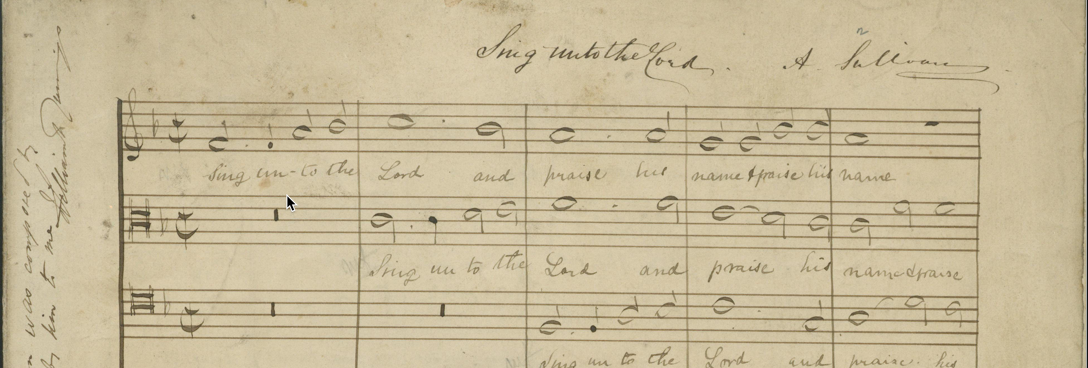
We also saw that in 1901, Christopher Bridgeman claimed to possess the autograph manuscript of Sullivan’s choral Sing unto the Lord, written when Sullivan was just 13 years old. Bridgman’s story of sharing that manuscript with Sullivan and his colleagues at a Savoy Theatre rehearsal made me skeptical of that claim. I noted another book from 1901 which says that the manuscript was then in the possession of Sullivan’s friend William Hayman Cummings.
After posting that article, I did some additional searching to see if I could locate the manuscript itself. Of the anthem Sing unto the Lord, the excellent G&S Archive says “Composed 1855. Unpublished. The MS was given by Sullivan to W. H. Cummings and sold at Sotheby’s in 1917.” That didn’t give me much hope.
To my delighted surprise, I then found a volume from 1953 entitled A census of autograph music manuscripts of European composers in American libraries, which contains exactly what it says “on the tin.” For Arthur Sullivan, it lists only two manuscripts, and one of those is Sing unto the Lord. Here is the census’s description of the manuscript:
[6]p. 30 x 24 1/2 cm.
For 4-part mixed chorus and piano or organ accept.
A marginal note on p. 1 reads: This anthem in the handwriting of Arthur Sullivan was composed by him when a boy in the choir of the Chapel Royal and given by him to me. William H. Cummings.
Former owner: William H. Cummings (catalogue, no. 187)
LIBRARY OF CONGRESS
Six pages? I have only seen one! The Library of Congress? Now we’re talking! And here’s where living in The Future comes in, because not 24 hours later, I had photographs of all six pages, thanks to the kind efforts of Dr. Paul Allen Sommerfeld of the Music Division of the Library of Congress (buy that man a drink next time you see him). Here’s the first page:
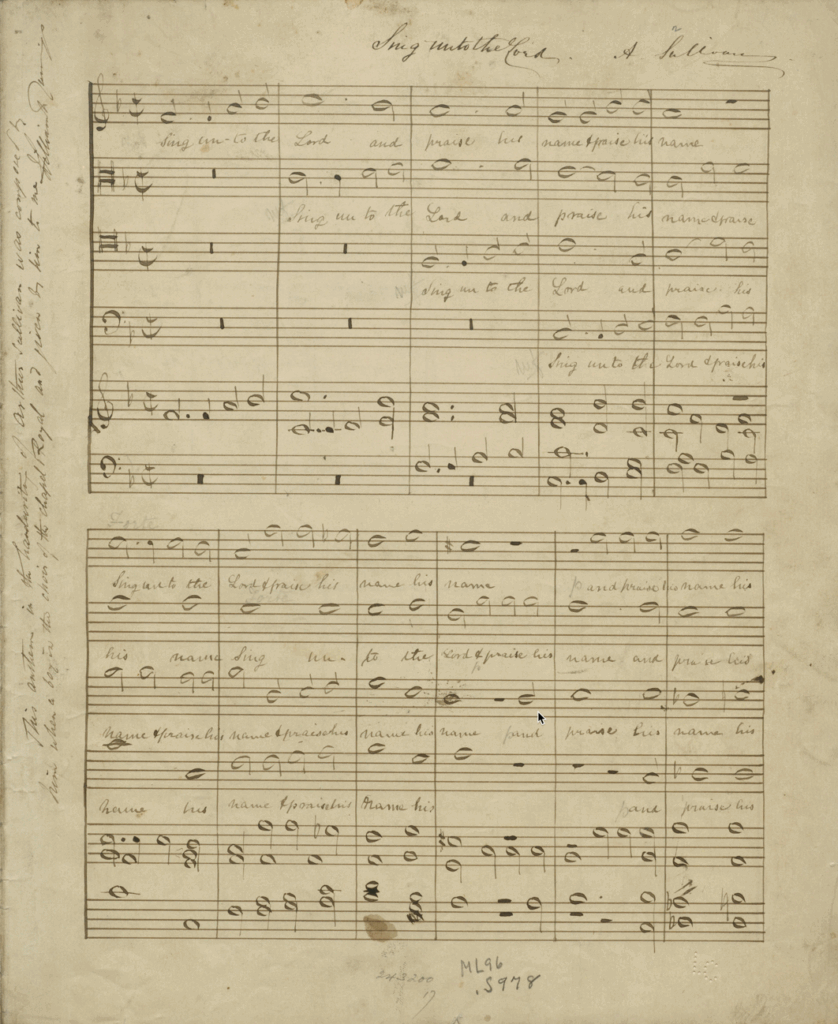
You can clearly see on the left side where Mr. Cummings wrote his note. The final page has his own library sticker:
William H. Cummings was a tenor and conductor, and a longtime Sullivan friend. He served as singing professor at the Royal Academy of Music for 15 years beginning in 1879, then became principal of the Guildhall School of Music. If you’ve never heard of the latter, think of folks today like James Galway and Ewan McGregor, to pick two random celebs from a very long list. To me, it is irrefutable that Sullivan would have, and did, gift an autograph manuscript to Cummings.
If you’re interested, here is a PDF of Sullivan’s 1855 anthem, Sing unto the Lord. Furnished by the generosity of American taxpayers.
If you have read Part 1 of this story, you must be dying to know, does it sound like the “refrain of ‘H.M.S. Pinafore'”? Well now you can HEAR FOR YOURSELF! Here’s an mp3 to listen to, and then—YOU decide. You can even leave your comments below.
Also, if you’d like to perform the anthem yourself, here is a bit of sheet music I whipped up for you.
In Part 2 of our story, I will share what I have found about the life of Cunningham Bridgeman.
But wait! I said there were two Sullivan autograph manuscripts in the Library of Congress
And the second one is equally rare and fascinating. It’s some of Sullivan’s early sketches for the music of Gilbert & Sullivan’s Trial by Jury. To me, this is astounding. With very few, minor exceptions, early sketches from Sullivan do not survive. And once again, Dr. Paul Allen Sommerfeld of the Music Division of the Library of Congress sends us the inestimable gift of a PDF of the entire manuscript!
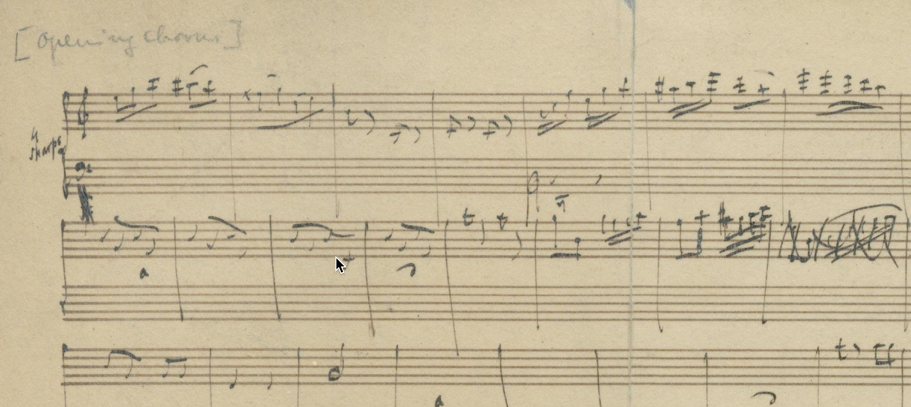
Here is the PDF of the full manuscript.
I love living in The Future.