
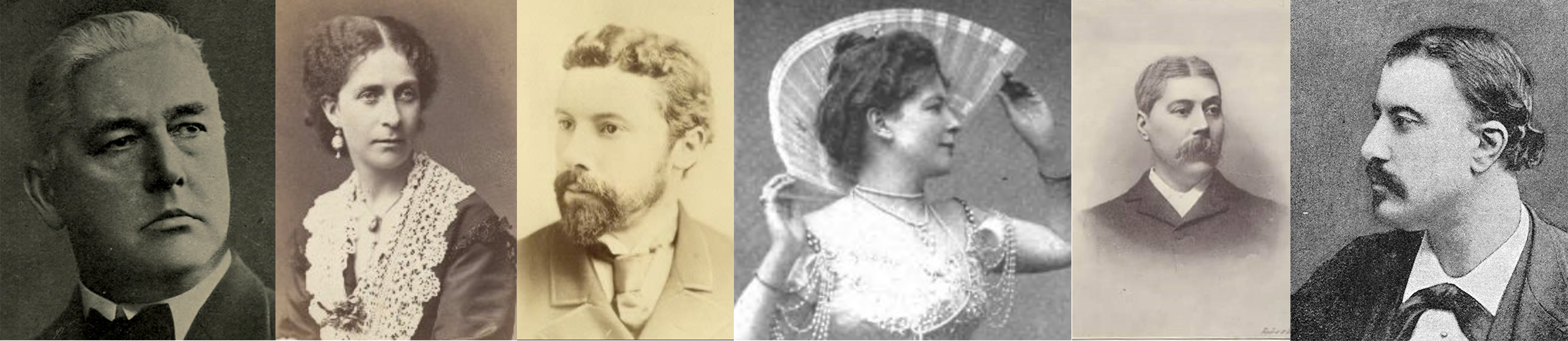
In this series on the identity of Gilbert and Sullivan biographer, Cunningham Bridgeman, we have questioned Bridgeman’s claims of special knowledge of Arthur Sullivan, and started to outline Bridgeman’s background. So far, he’s proven to be an interesting young 19th century person, but no one out of the ordinary.
Because I fear your interest in Mr. Bridgeman may have waned, I’m going to begin this post with a teaser. Every once in a while, in the work of historical research, one is suddenly, unexpectedly stunned. Here is an example:
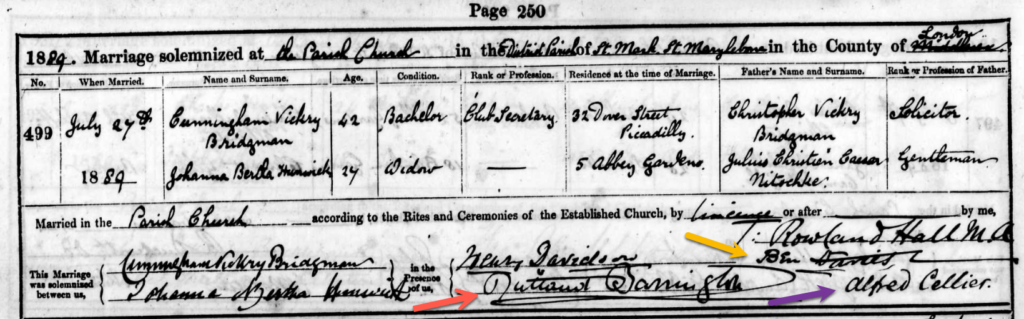
This is a London marriage record from 1889, in which Cunningham Vickry Bridgman, age 42, weds Johanna Bertha Hunwick, a widow at only 27. Usually on this form, two persons sign their names as witnesses, but in this case the happy couple have brought four. I have pointed three out with arrows. The gold arrow points to Ben Davis, an operatic tenor, best known to Sullivan fans for singing the title role in Sullivan’s grand opera, Ivanhoe. The purple points to Alfred Cellier, the composer and conductor who first met Sullivan—and Cunningham’s older brother, Christopher—as a boy at the Chapel Royal. And the red arrow points to Savoy Theatre superstar Rutland Barrington.
Apparently a lot has happened
since we left Bridgeman’s career as a London railway clerk in 1871. One clue we are given here is his new profession, Club Secretary. More on that later.
But who was Johanna Hunwick? Born Johanna Bertha Nitschke, in 1884 she marries an accountant called Edward John Hunwick. He apparently dies in 1888. Johanna develops an interest in the stage, where she adopts the name Christine Valmer. During 1900, her stage name evolves from Miss Christine Valmer to Christine Valmar—perhaps because another another rising actress of the time is a Miss Rosaline Valmer—to Madame Christine Valmar—perhaps because she is a married woman—to Baroness Valmar. I don’t know where she was born, but she probably had a Slavic accent.
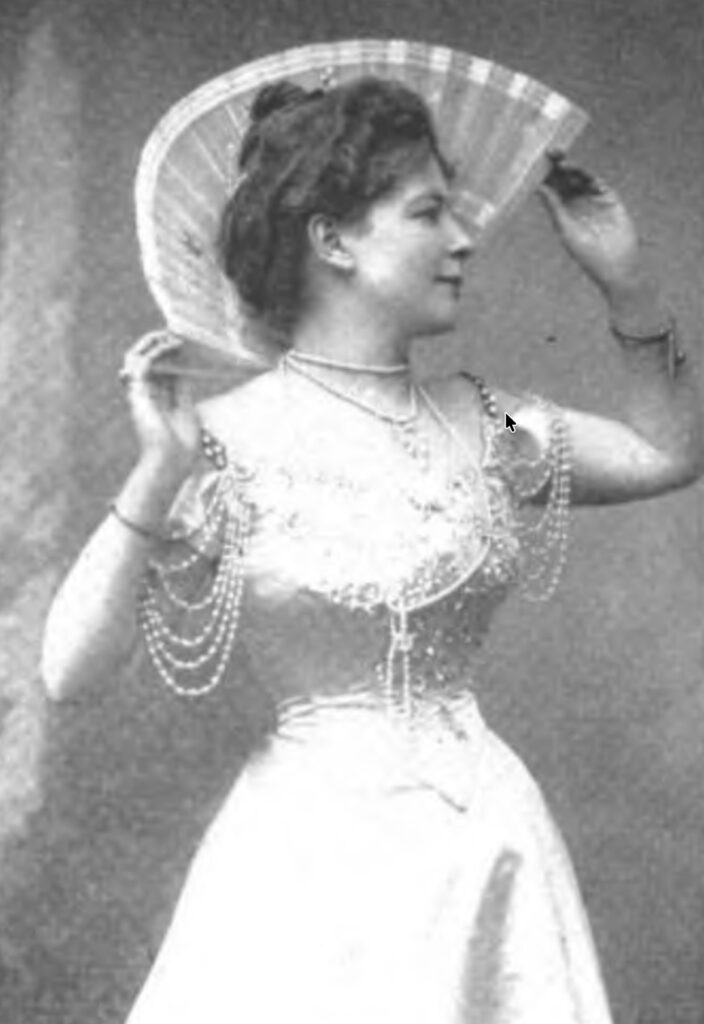
The Sketch, of June 6, 1900 writes:
The Baroness Valmar, who is singing ballads at the Tivoli, is a member of a distinguished Russian family. Her parents left their native land for political reasons and settled in Germany, where she received her early musical training, studying under Professor Wieber, of Berlin, and at the Conservatoire in Leipzig. The Baroness has also studied under Signor Franco Leoni in London, and stage-dancing under Espinosa. She made her début in London at the Punch Matinée, and was at once engaged by Mr. Morton to sing at the Palace during August and September.
Of all that info, I can verify that she sang at the Tivoli and at the Palace Theatre (formerly Richard D’Oyly Carte’s Royal English Opera House). After 1900, she disappears from my newspaper sources, possibly because in that year Cunningham sued her for divorce, rather publicly. Included in the action was a man called Alexander Gordon Ross. Bridgeman claimed that Johanna was sleeping with Ross in his London hotel. The suit went to trial. Neither Ross nor Mrs. Bridgman testified, but Ross offered to pay £500 to settle the case, and Bridgman accepted.
Ross, known as Alick to his family, was the grandson of Sir Alexander Cornewall Duff-Gordon, 3rd Baronet. His mother Janet Ann Ross was one of those socialites who seemed to know everyone, not just in England but also in Egypt and Italy, where she owned a Tuscan castle. Her life is recounted in the book Queen bee of Tuscany — the redoubtable Janet Ross, by Ben Downing—a good read. But not even Janet’s biographer knows much about Alick, as neither she nor his father, banker Henry Ross, spent much time with the boy. A scan of census records shows that in 1901 Alexander Gordon Ross is married to a 29-year-old Russian woman named Christine, and in 1911 he is married to a 28-year-old Russian woman named Olga. Perhaps, in life partners, he had a type.
There was a little surprise in Cunningham’s divorce proceedings
Once word got about that Bridgeman was to receive £500 in compensation from Ross, a Mr. Edward Coryton Engelbach petitioned the court, essentially saying, “Hang on, that Bridgeman fellow still owes me £187 from back in 1896, when I sued both him and his brother Christopher.” Mr. Engelbach, better known as “E. C.” , was the business partner of Mr. William Greet. If you know your late Savoy Theatre history, you know where this is going.
Again from The Sketch, May 29, 1901:
Since my last week’s paragraphs concerning the future of the Savoy Theatre, it has been decided that Mrs. D’Oyly Carte shall next Quarter Day (June 24, to wit) hand over the lease of that long and deservedly popular playhouse to Mr. William Greet. Mr. Greet, as The Sketch pointed out last week, had for many months desired to acquire the Savoy and all its appurtenances for himself and partner, Mr. E. C. Englebach.
I believe I have already compared Cunningham Bridgeman to Forrest Gump?
How did Cunningham Bridgman develop so many connections in the theatre?
Rewinding the tape, back to 1871…
As we saw in Part 3, by 1870 Cunningham Bridgman has published a children’s toy book called Ridiculous Robinson Crusoe, and in some unidentified year he spent time in a naval hospital where he wrote a play. That play is called Shipmates, and while it isn’t really a musical, it does contain three songs. If you have some song lyrics to be set to music, and you once met a boy who is now a famous composer, what do you do? According to Cunningham:
I went straightway to Arthur Sullivan and asked him if he would do me the favour to compose the music of a song incidental to my comedy. Sullivan, being busily engaged on his oratorio The Light of the World, was unable to oblige me, but he gave me a letter of introduction to Mr. Frederic Clay, one of the most kind-hearted and genial men it was ever my pleasure to meet.
So far as I can tell, this was Bridgeman’s entrée into what would become the world of Gilbert and Sullivan. The year was probably 1872. Note Bridgeman’s ambiguous verbage, “I went straightway to Arthur Sullivan”. Was that a face-to-face meeting, or a letter? I don’t know. Bridgeman often uses vague language to describe interactions with Sullivan.
Perhaps due to the introduction from Sullivan, Frederic Clay sets one song for Shipmates, entitled Lover Mine. Like Sullivan, Clay is also busy in this period; by 1873 he had composed music for several shows, including three with W.S. Gilbert—such as the hit Ages Ago—while working his full time job at Her Majesty’s Treasury.
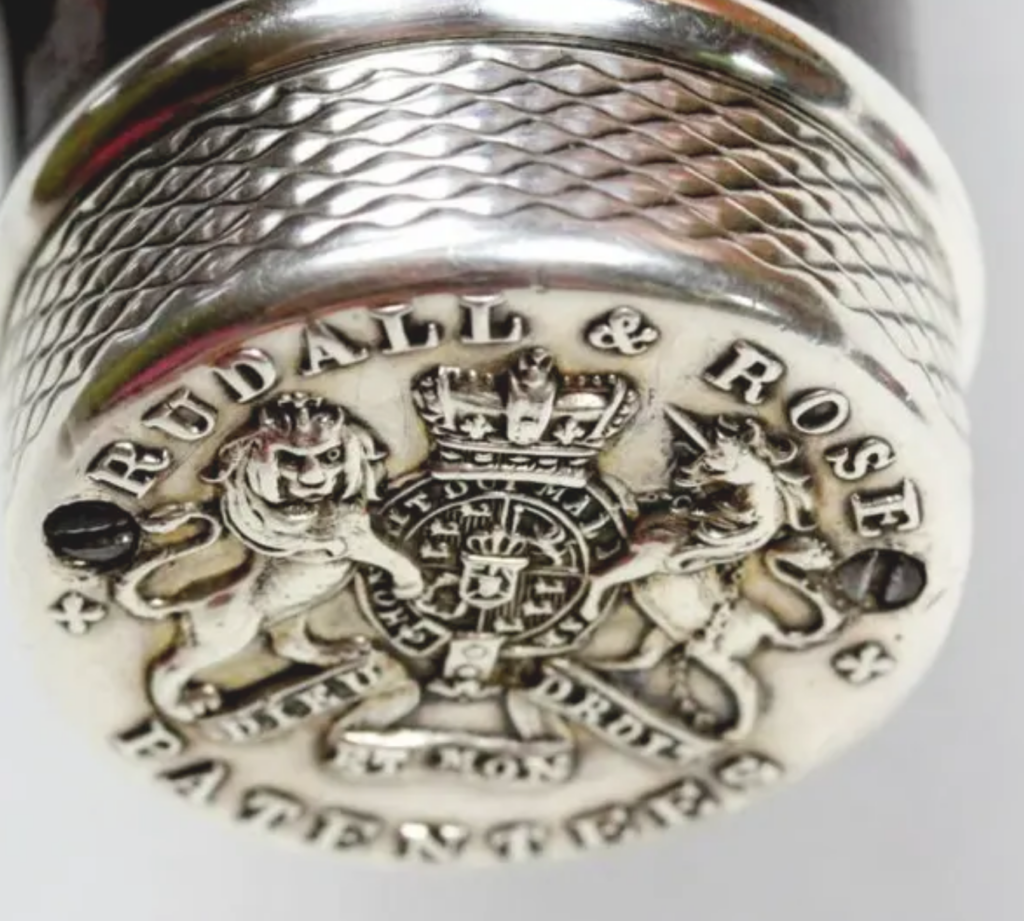
According to Bridgeman, Clay also introduces him to another young composer for the stage, Richard D’Oyly Carte. At this time Carte is working in his father’s business, Rudall, Carte & Co. (Attention: Richard D’Oyly Carte’s father is also called Richard Carte.) That company started life as Rudall & Rose. They made flutes of their own design, and sold other instruments, eventually merging with a band instrument company.
Richard Carte Sr, was a professional flautist who also gave lectures on musical instruments. By 1851, Carte Sr is designing flutes for Rudall & Rose. By 1852 Carte Sr is a full partner in the firm. By 1853 they are also publishing music. By 1869, Richard D’Oyly Carte is also working in the firm, and is the manager of the London Opera, Concert and Choir Agency, which represents musical artists and educators.
Hence meeting Clay and the Cartes will plunge Bridgeman into a large and growing network of Victorian writers, musicians, and performers. This is a pattern which dominates Bridgeman’s life. He makes the acquaintance of—and sometimes forges friendships with—several writers, composers, and artists who are important to the success of Gilbert, Sullivan, and the wider Savoy Theatre milieu.
He was probably a skillful networker, but in my current research I have found almost no evidence that Bridgeman ever enjoyed a close friendship with Sullivan.